The Refinery for Waste no one had priced correctly
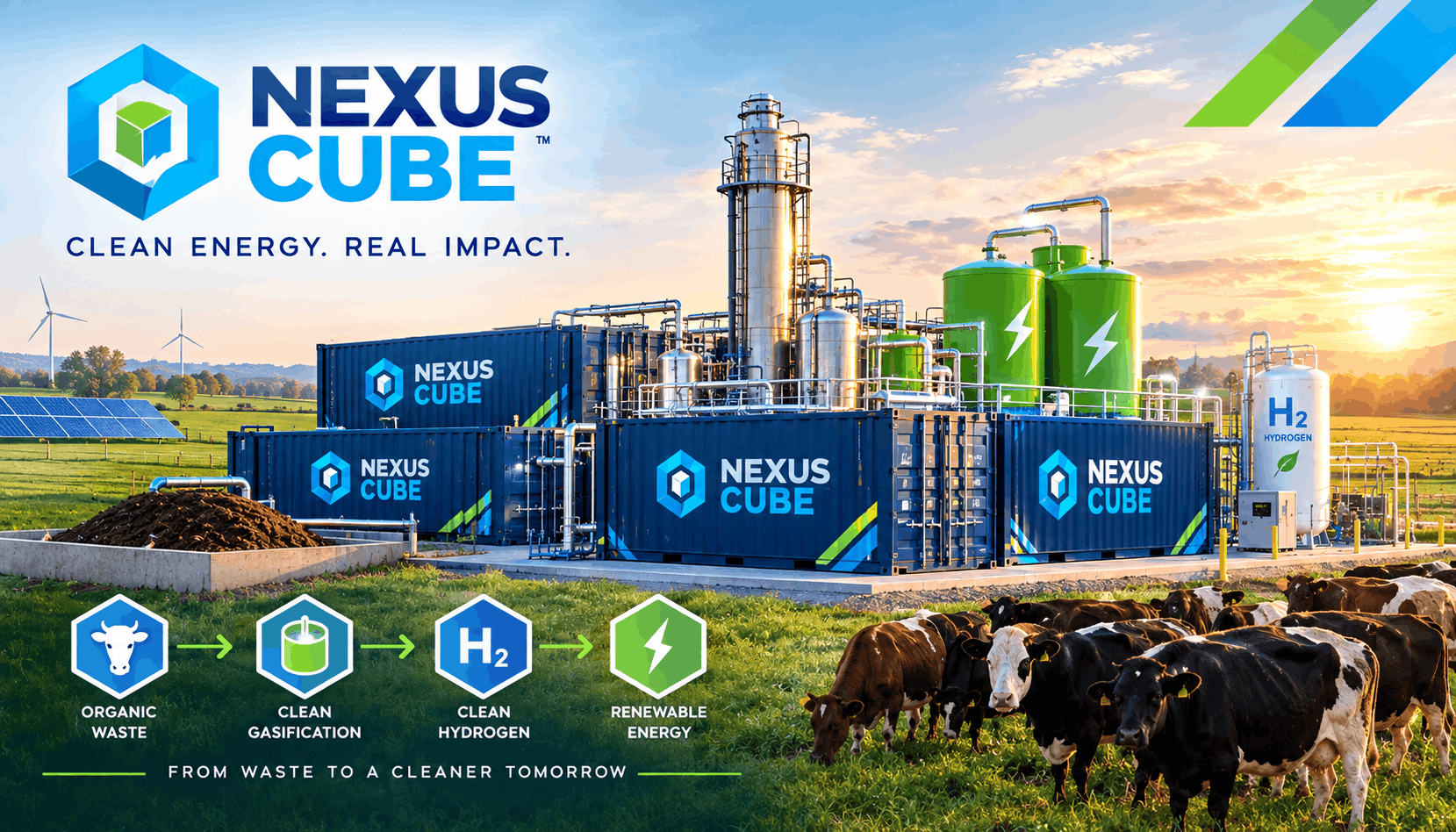
GH2E converts municipal, agricultural, and industrial waste streams into hydrogen and clean water in a single integrated process — while running on the energy already sitting inside the waste itself. Fully containerised to produce the cheapest and cleanest source of remote, autonomous hydrogen.
800–1,200°C
on-site plasma processing temperature
2 subsystems
Hydrosparq™ + Dimension Water™
carbon-negative
emissions intensity, under the right feedstock mix
Where we're being candid: plasma torches have been power-hungry platforms. By running a hydrogen capture facility autonomously — burning a fraction of its own syngas rather than drawing from the grid — the performance gains are real, and engineering studies now show measurable improvements in exergetic efficiency as reliance on the waste-derived energy loop increases.
The key question about GH2E was never about the design or its internal chemistry. That groundwork was settled well before commercial rollout. The real gap has been market forecasting: waste volumes have risen faster than the models built to price them, leaving a technology-ready asset sitting ahead of a market which hadn't caught up to its value. That's the shift that is underway. GH2E moving from an equipment sale to an infrastructure-grade asset, the kind investors underwrite on cash flow and utilisation rather than novelty.
What separates GH2E from the pitch decks promising imminent scale isn't a technical risk — it's a maturity mismatch. Those decks project throughput curves the underlying chemistry hasn't earned yet: hydrogen yield at scale still runs against unresolved feedstock characterization, the kind of variable that doesn't disappear because a slide says "Year 3." GH2E's chemistry has already cleared that bar on the treatment side; what's lagged is the market's ability to underwrite it as infrastructure rather than price it as a novelty. At NexusInnovest, we see it as an execution story, not a science project.
"Biomass, if managed sustainably, can provide the 'sink' for carbon that, if utilized in concert with low-carbon generation technologies, can enable us to reduce carbon in the atmosphere."
GH2E doesn't just avoid emissions; it can reach carbon-negative
Carbon-negative capacity isn't a niche ESG line item anymore. it's becoming a standard budget category across sectors that have nothing to do with energy or waste. The global carbon credit market is projected to grow from roughly $114 billion in 2025 to nearly $482 billion by 2035, and the fastest-growing slice by far is removal, not avoidance, expanding at a 26.4% annual rate while legacy offset categories remain stagnant. Buyers are enforcing that split themselves in what they'll pay: avoidance credits trade below $10–15 per ton, while verified removal credits command $150–500+ a ton — a 10-to-50x spread for what is nominally the same metric ton of CO2. That premium tier is being paid into by an increasingly wide buyer base
A hydrogen platform that is verifiably carbon-negative, not merely carbon-neutral, is built to sell into that premium tier — not compete in the crowded, cheap end of the market where legacy avoidance credits already live.
Avoidance
Most organic waste decomposes anaerobically into methane — a gas with roughly 27-28 times the warming impact of CO2 over a 100-year horizon. Routing that same waste through Hydrosparq™ releases biogenic CO2 instead of methane, avoiding that higher-potency emissions profile relative to the business-as-usual case — a reduction that holds up before the hydrogen capture process is fully engaged.
Capture
Plasma gasification produces an unusually clean, concentrated syngas stream, which makes in-situ CO2 sorption — using materials like metal oxides and catalytic reformes — more tractable than in most gasification routines. Stacked on the avoided-methane credit, the resulting hydrogen is measurably carbon-negative, not just rhetorically when a syngas stream can be separated in real-time.
Destruction value
Extreme process heat destroys pathogens and breaks down persistent contaminants in the same pass. A facility processing sewage sludge or dairy wastewater isn't only making hydrogen — through Dimension Water™, it's effectively replacing the treatment plant. That value not only sits outside most carbon-accounting frameworks, but also shifts the entire platform from a linear to dimensional process.
Avoidance, capture, and destruction value aren't separate line items competing for attention. They're three ways of underwriting the same tonnage of waste, which is exactly the layered, verifiable credit profile the market's highest-paying buyers are already seeking out commercially.