 Source: ©2026 Perisio Media
Infinite, Remote Power Without Pollution
Green hydrogen has emerged as a critical solution for the global energy transition, offering a versatile and clean alternative to fossil fuels in the hardest-to-abate sectors of the economy. As of August 2025, the momentum behind hydrogen is unprecedented, with more than 60 countries adopting national hydrogen strategies and significant policy and investment actions underway to scale up production, distribution and infrastructure. Supportive technologies are now poised to play a pivotal role in decarbonising heavy industry, long-distance transport and aviation, while also enabling long-duration energy storage to stabilise grids with higher renewable penetration and new standards to advance its use across regions, borders and timezones.
Market forecasts show significant variation in size estimates for 2025, ranging from approximately USD $5.77 billion to USD $12.31 billion, reflecting different methodologies and scope definitions used by various research firms. However, all sources agree on the rapid growth trajectory of the green hydrogen market that is driven by decarbonisation efforts and an undisputed need for renewable energy expansion.
The question now isn't whether hydrogen will play a major role in the energy transition, but how quickly it can scale to meet industry and deployment demands. The countries and companies that move decisively to develop hydrogen capabilities today will be best positioned to thrive in tomorrow's clean energy economy. These advantages spell out why stakeholders should examine the industry further, and how it compares with other technologies and renewable energy sources.
The Strategic Advantages
Green hydrogen produced through GH2E-class systems offers a number of strategic advantages when compared with other hydrogen production methods. While most production methods are focused on electrolysis and steam methane reforming (SMR), innovations in biomass gasification and remote catalytic reformers have adjsted the outlook and viability.
Environmental Benefits: Green hydrogen is considered a carbon-neutral energy source that is compatible with nearly every sustainable energy source. In some cases, where biogenic carbon feedstocks are used, emissions can be classified as carbon-negative, which is the gold standard for environmental compliance. This contrasts sharply with gray hydrogen (produced from natural gas via steam methane reforming) which generates significant CO2 emissions, and blue hydrogen (gray hydrogen with carbon capture) which still produces some emissions and relies on fossil fuel infrastructure.
Energy Security and Independence: Green hydrogen can be produced in every energy domain using local resources and feedstocks, reducing dependence on fossil fuel imports and volatile global energy markets. Countries with abundant renewable energy potential can become hydrogen exporters rather than remaining dependent on oil and gas imports. When applying agricultural and food waste as a feedstock in remote settings, autonomous applications can operate without commercial grid access — adding a new layer of energy security to ageing or stagnant infrastructure.
Industrial Decarbonisation Potential: Green hydrogen is uniquely positioned to decarbonise the hardest-to-abate industrial sectors like steel production, cement manufacturing, and petrochemicals where direct electrification isn't feasible. It can serve as both a feedstock and energy source for these industries.
Long-Term Cost Trajectory: While currently more expensive than gray hydrogen, green hydrogen costs are declining rapidly as the technology alternatives expand. The International Energy Agency (IEA) projects green hydrogen could become cost-competitive with gray hydrogen in many regions by 2030.
Storage and Grid Balancing: Green hydrogen can store excess renewable energy for weeks or months, addressing the intermittency challenges of solar and wind power. This makes it valuable for seasonal storage and grid stabilisation where variable energy demands place additional stress on infrastructure.
Policy and Investment Alignment: Green hydrogen aligns with net-zero commitments and climate policies, making it eligible for market incentives and impact investments that other hydrogen types may not qualify for.
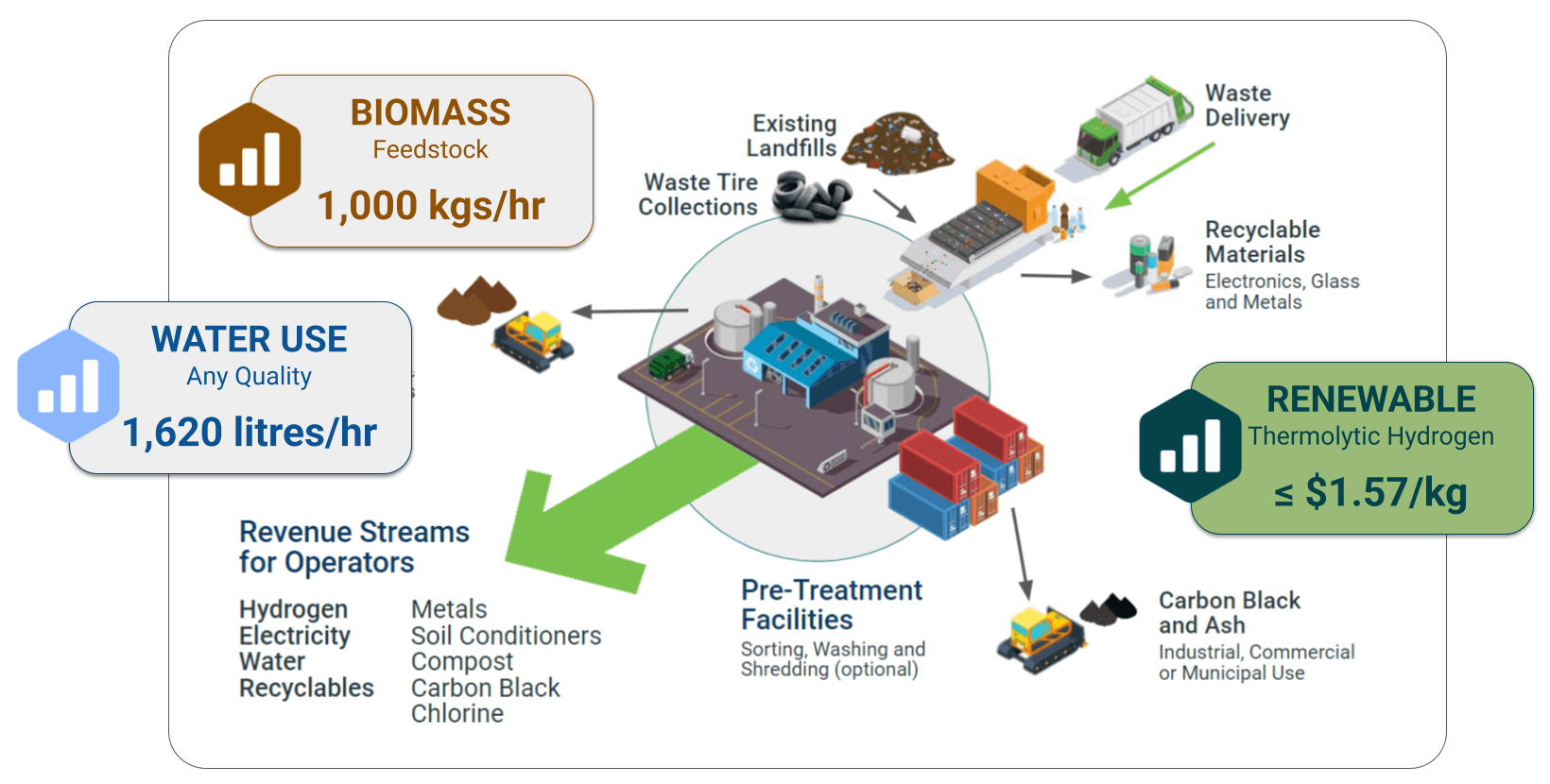 The GH2E-150 Class process flow diagram — an 8-core hydrogen capture unit.
Feedstock Flexibility: One key advantage is plasma gasification's ability to handle diverse feedstocks. The hydrogen-to-carbon ratio is improved by a thermochemical conversion that breaks carbon bonds and adds hydrogen to gaseous products. This means it can process various waste materials, biomass, and even coal, providing operational flexibility that many other hydrogen production methods simply lack.
Process Control and Temperature Management: Plasma technology generates extremely high temperatures in a controlled chamber, allowing for complete molecular breakdown and reformation. This enables more complete conversion of feedstock compared to conventional gasification methods which operate at lower temperatures.
Energy Efficiency and Process Intensity: Plasma-assisted hydrogen production has gained significant attention due to its high efficiency, environmental friendliness, and flexibility, which also has advantages in terms of its dependability across numerous energy domains and access points.
Lower Infrastructure Requirements: Plasma gasification systems can be more compact than traditional large-scale steam methane reforming plants, reducing capital costs and enabling distributed hydrogen production closer to end users and unique project scenarios.